Editor’s Note: We’re going to be featuring a couple of articles we’d typically be putting on the Premium Side of DLF over the next week or so. We’ve been fielding a lot of requests from members to see just what some of those articles entail, so here’s one we had scheduled. If you haven’t signed up as of yet, you’ll see these articles cover a wide variety of subjects. Enjoy your free preview!
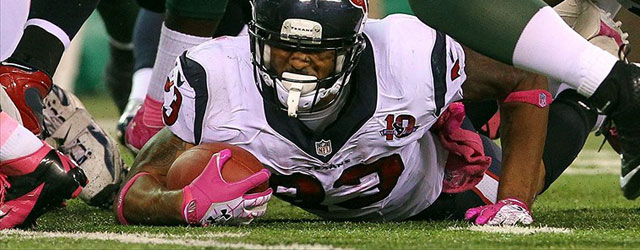
No, I’m not talking about scorned fantasy owners poking needles into their Arian Foster voodoo dolls following his week 16 fantasy championship clunker. I’m referring to arguably the biggest fear (since ACL recovery times seem to be improving) dynasty owners face with their stud ball carriers – “The Curse of 370.” In layman’s terms, “The Curse of 370″ states that running backs who have 370 or more carries in a given season are likely to fall off a statistical cliff in ensuing years due to being overworked. This means that not only will they play less efficiently, but they’ll also be more susceptible to injury.
So how does this relate to Foster?
He has just now concluded his 2012 regular season with 351 carries (not quite 370, but as Cynthia said to Agent Cooper in Red, “this is happening either way”) and 40 catches, for a total of 391 touches. This isn’t even taking into account the usage he’ll receive in the playoffs, as Houston is locked into at least one more game. However, as Calvin Johnson has recently proven, curses (albeit some more abstract than others) are meant to be broken. With that in mind, it’s time to look into the likelihood of whether Foster can overcome his own jinx.
While it’s not 100% effective to directly compare one player to another, past precedence is the only thing to work with in this case. In that spirit, the following analysis will look at running backs in the past ten years who ran the ball approximately 370 or more times in a season and how their subsequent numbers fared relative to those before they were “cursed.” Depending on the results, the players in question will be deemed as having had positive responses, negative responses, or, for various reasons, neither (outliers).
As always, factors such as age and previous utilization will be taken into account in this investigation, although determining which data to include was an “objectively subjective” process. In general, the only years included were those where the running back’s usage fit his general career trend, almost always occurring when the player in question was starting. Exceptions are explicitly noted, with rationale given. So without further preface, it’s time to attempt to forecast Foster’s fate.
Positive Responses
LaDainian Tomlinson
NFL season when 370 carries occurred: Second
NFL touches before 370-carry season: 398 (339 carries)
Stats during 370-carry season:

Comparative statistical analysis:
Interpretation:
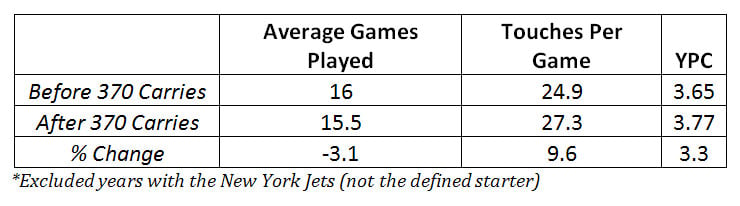
Not only did LT not succumb to “The Curse,” he actually had his best rushing average (5.3 ypc) in 2003, the year directly following his 372-carry season. As shown in the table above, Tomlinson also continued to show a combination of good health and improved numbers throughout the duration of his remaining seven years with the Chargers. The likeliest conclusion to draw here is the concept of a direct correlation between age/cumulative usage and the effect of the curse. Tomlinson’s “cursed” season was only his second in the league, when he had a mere 339 carries to his name. It’s probable that a combination of youth and fresh legs helped LT stave off any kind of immediate statistical letdown.
Adrian Peterson
NFL season when 370 carries occurred: Second
NFL touches before 370-carry season: 257 (238 carries)
Stats during 370-carry season:

Comparative statistical analysis:
Interpretation:
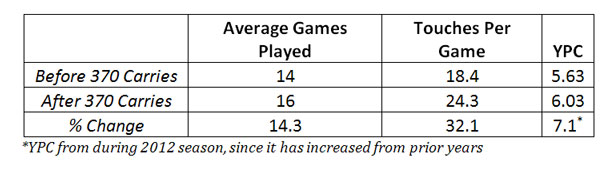
Peterson’s inclusion in this list isn’t necessarily fair, since he averaged 5.63 yards-per-carry in his rookie year as a “co-starter,” which also doubles as the only year before his “cursed” season. Natural regression was expected, although AP still averaged over 4.4 yards per carry in the three subsequent years after 2008. Then 2012 happened, and Peterson proved to us all that he is indeed a superhuman, averaging 6.03 yards per carry en route to a 2,000-yard year, both career bests. This shows that Peterson has bounced all the way back (and then some) from his 2008 campaign, and because of this only his 2012 statistics will be used for the “after 370 carries” YPC cell. With all that said, the numbers speak for themselves, and AP has proven yet again that young running backs with light workloads can ultimately break the Curse.
Chris Johnson
NFL season when 370 carries occurred: Second
NFL touches before 370-carry season: 294 (251 carries)
Stats during 370-carry season:

Comparative statistical analysis:
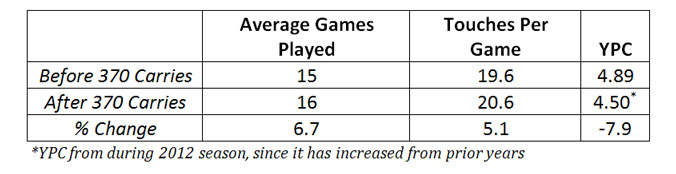
Interpretation:
Johnson is another tough player to gauge, as he posted otherworldly statistics in his first two seasons. In fact, during his 2009 season, Johnson actually set the NFL record for most yards from scrimmage. In this case, some amount of regression would be expected. While CJ2K’s numbers have dipped in recent years, he’s back up to 4.5 yards-per-carry in 2012, despite dealing with the combination of Matt Hasselbeck and Jake Locker under center. Because he is still improving years after his “cursed” season, only his 2012 statistics were used in the table above. So despite the overall decrease in yards-per-carry, Johnson has remained healthy despite increased usage, and can therefore be categorized as having a positive response.
Negative Responses
Jamal Lewis
NFL season when 370 carries occurred: Fourth
NFL touches before 370-carry season: 799 (720 carries)
Stats during 370-carry season:

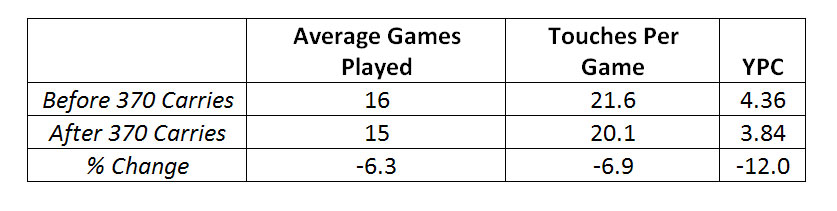
Comparative statistical analysis:
Rudi Johnson
NFL season when 370 carries occurred: Third
NFL touches before 370-carry season: 259 (232 carries)
Stats during 370-carry season:

Comparative statistical analysis:
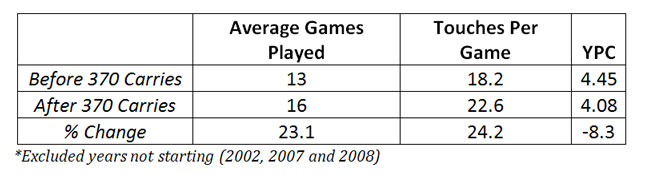
Interpretation:
Johnson’s numbers suggest a dichotomy of sorts, in that his games played and touches per game averages increased following his “cursed” season in 2004, while his efficiency decreased. The first part could be explainable by the fact that Corey Dillon was entrenched as the Bengals’ starter until he got hurt in the third contest of the 2003 season, leading to Johnson’s involvement in only the subsequent 13 games – this would skew the “average games played” number before his “cursed” season, since it was the only year which fell into that category.
It’s tough to place Johnson because he broke the 1,400-yard barrier again in 2005, showing a greater efficiency than in his 2004 season. This was likely due to a combination of age and relatively low usage. However, 2005 was also Johnson’s final season averaging above 4.0 yards-per-carry, and he ultimately faded into oblivion just three seasons removed from 2004. For that reason, Johnson is considered to have been touched, if only slightly, by the Curse.
Shaun Alexander
NFL season when 370 carries occurred: Sixth
NFL touches before 370-carry season: 1,557 (1,382 carries)
Stats during 370-carry season:

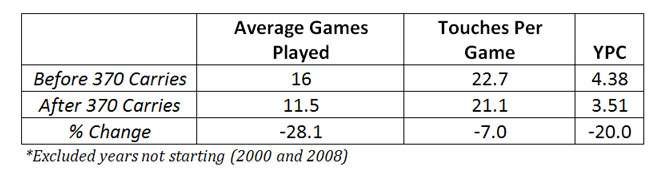
While Alexander appears to offer up a pretty open and shut case, it should be noted he carried the ball 353 times in 2004, the year before his “cursed” season. Even despite that, he still set career bests in 2005, when he hit 370 carries on the nose. Most notable in Alexander’s case is that he was 28 years old during that season and already had precious little tread left on his tires (1,557 cumulative touches already). It’s unsurprising his numbers fell precipitously in his final years, suggesting that older running backs with previously heavy workloads are less inclined to survive the Curse.
Larry Johnson
NFL season when 370 carries occurred: Fourth
NFL touches before 370-carry season: 532 (476 carries)
Stats during 370-carry season:

Comparative statistical analysis:
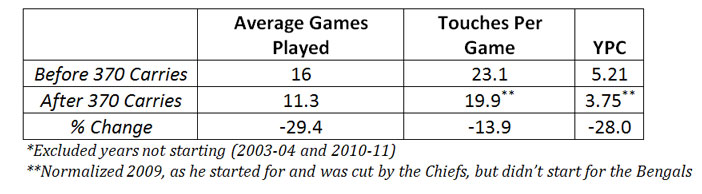
Interpretation:
LJ appears to be in a class of his own, as he had a relatively lesser amount of total touches before his 2006 season, but fizzled out almost immediately after. It’s likely due to the fact he had a whopping 416 (416!) carries in his “cursed” season, which in addition to being an extraordinary amount, actually represented 47% of his career carries to that point, despite Johnson being in his fourth NFL season. This increase in usage likely provided a pronounced shock to his physical wellbeing. Needless to say, Johnson missed 12 total games in the following two seasons, and his yards-per-carry average in 2007-2009 dropped by 28%. In fact, he only averaged 176 carries during those years, which was a full 200 fewer than what he averaged in 2005-2006. Suffice it to say, Larry Johnson embodies and defines the Curse of 370.
Michael Turner
NFL season when 370 carries occurred: Fifth
NFL touches before 370-carry season: 286 (274 carries)
Stats during 370-carry season:

Comparative statistical analysis:
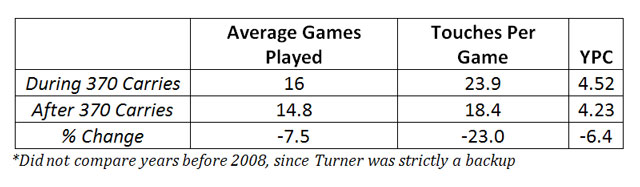
Interpretation:
It would be disingenuous to compare Turner’s pre-2008 statistics to his numbers in 2010-2012, as he was strictly LaDainian Tomlinson’s caddy with the Chargers. Therefore, the above table has been slightly modified to show how Turner’s 376-carry season in 2008 (with the Falcons) compares to what he’s done since. While his yards per carry haven’t dropped dramatically, Turner has received nearly five fewer touches per game. He also missed five games in 2009, again lending credence to older players struggling with injuries following high-usage seasons. While it’s likely that Turner’s steady decline is due in large part to Father Time’s influence (as well as a changing Atlanta offense), it’s still noticeable given his sparse utilization prior to being “cursed.”
Outliers
Ricky Williams
NFL season when 370 carries occurred: Fourth (2002), Fifth (2003)
NFL touches before 370-carry season: 946 (814 carries)
Stats during 370-carry seasons:

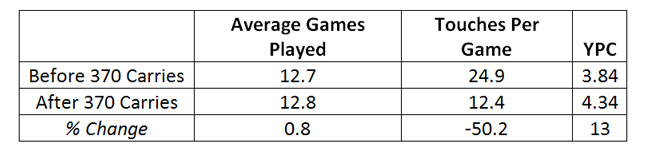
Interpretation:
Though Williams’ largest workload in the years following his 2002/2003 seasons wound up being only 241 carries, it’s tough to draw a logical conclusion about whether or not he succumbed to the Curse. “Reefer Ricky” was forced to sit out both the 2004 and 2006 seasons due to violations of the league’s drug policy, and never regained a true starting job in the NFL. This lesser usage in his later years, combined with the two years off, could help explain how his running efficiency actually increased late in his career. However, it should be noted that Williams’ rushing average dropped by 1.3 yards in the season immediately following his 383-carry campaign, though he did stay healthy enough to set a career high in carries (392).
Edgerrin James
NFL season when 370 carries occurred: First (1999), Second (2000), Seventh (2005)
NFL touches before 370-carry season: 2,307 (1,972 carries)
Stats during 370-carry season:

Comparative statistical analysis:
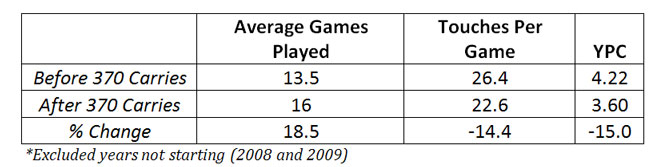
Interpretation:
Despite how it looks at first glance, James actually offers up evidence both supporting and disproving the curse. While ESPN’s seasonal statistics only go back to 2002, the individual player statistics go back even further. When perusing James’ player profile, one can see that 2005 was actually the third time he carried the ball 360 or more times in a season. In 1999 and 2000, James’ first two seasons in the NFL, he carried the ball 369 and 387 times respectively. It’s true he missed time due to injury in the following years (only six games played in 2001, and an average of 11 games played in 2001-2003), but his subsequent efficiency remained the same (and actually better in 2004). A younger James appeared to have survived the Curse.
Old Man James, however, is a different story. Following his third year of approximately 370 carries in 2005, he only started two more seasons, failing to crack 4.0 yards-per-carry in either. However, at this point in his career, he was in his late twenties and already had over 2,000 carries to his name. One mitigating factor could be that he was no longer playing in the Indianapolis backfield with one of the all-time greats in Peyton Manning, but as already seen above, there does appear to be a direct relationship with age/cumulative usage and the effect of the Curse.
The Man in Question
Arian Foster
NFL season when 370 carries occurred: Fourth
NFL touches before 370-carry season: 845 (710 carries)
Stats during 370-carry season:

Comparative statistical analysis:
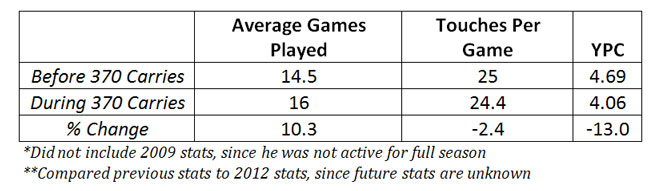
Since we don’t yet know what Foster’s future holds, the above table has been tweaked, this time to compare his 2012 numbers to statistics in previous years. While Foster was already experiencing a slight statistical regression the past two seasons (4.9 ypc in 2010, 4.4 ypc in 2011), it’s fair to wonder how much this current drop to 4.1 yards per carry has to do with usage. Though his overall touches are down, this is due to a drop in catches, not carries.
In his age-26 season, with 710 totes already under his belt, Foster has exceeded his previous high in carries by 24, or slightly more than a full game. This rate was even higher going into week 16, when Foster exited early due to an irregular heartbeat. While there are mitigating factors (40% turnover on the offensive line), it’s fair to wonder if Foster is beginning to wear down.
Graphical Analysis
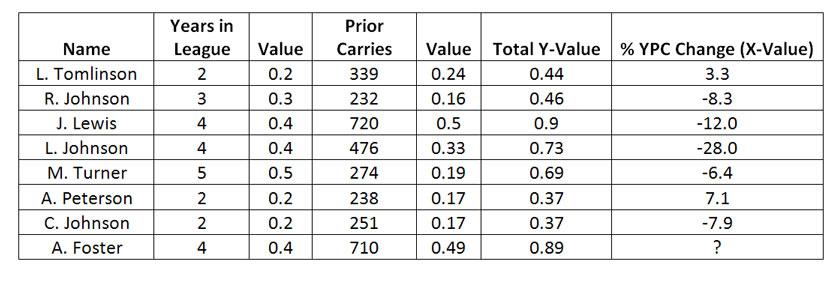
Removing Ricky Williams (two missed years), Edgerrin James and Shaun Alexander (significantly more cumulative carries before their “cursed” seasons) from the analysis, a definitive trend can be observed. Factors considered include what season each player was in when they received (roughly) 370 carries, as well as how many carries each had prior to that season. Each of these factors is weighted equally (0.5), for a maximal additive value of 1.0.
For example, Michael Turner was in his fifth year when he received 376 carries, which is the largest value of the group. Therefore he receives a score of 0.5 for the “years in league” category. LaDainian Tomlinson was only in his second season when he received 372 carries, so he would receive a score of 0.2 for the same category.
Jamal Lewis paced the group in the “prior carries” category with 720, which will therefore denote a score of 0.5. Tomlinson, conversely, had only carried the ball 339 times before his “cursed” season, which is roughly 47% of Lewis’ 720 carries. LT is therefore assigned a score of 0.24 (47% of 0.5) for “prior carries.” The additive effect of each player’s scores for “years in league” and “prior carries” will denote the Y-values for the graph.
The corresponding X-values in the graph correlate to the previously calculated percent change in yards-per-carry following each player’s “cursed” season. These values can be found in the lowest right-hand cell under each player’s “comparative statistical analysis.” All of this is summarized in the following table, and subsequent graph:
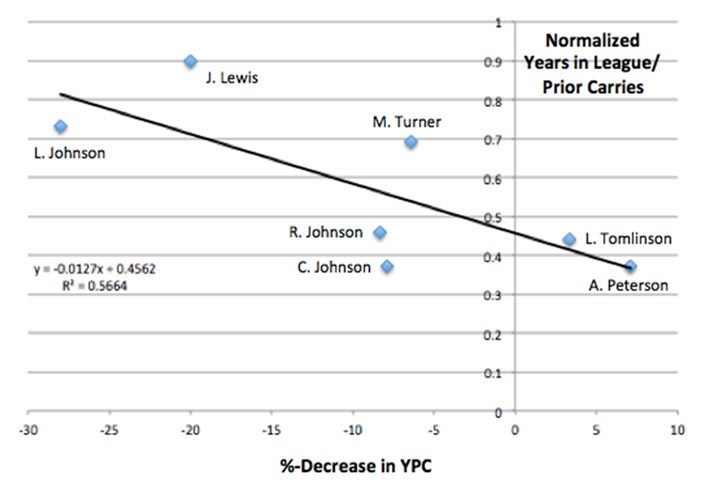
As for Arian Foster, we now have enough data to predict his future. Foster’s Y-value (fourth year in the league, 710 prior carries) of 0.89 can now be plugged into the equation for the trend-line. Doing so suggests that Foster’s statistics will fall off by a whopping 34.2% over the duration of his career! Of course, this is inexact, especially considering the afore-mentioned exceptions. The R2-value of the “best-fit” line is a horrific 0.57, so take that number with a humongous grain of salt. After all, it’s unreasonable to expect Foster’s game to bottom-out worse than a guy (Lewis) who went to jail mid-career, after all. However, the warning signs are too much to ignore.
Conclusion
Again, these types of predictions are, by their nature, inexact. It’s irrational to compare players directly to one another, but unfortunately that’s the best we can do in situations like these. So while the math above is skewed, it still likely paints a broad stroke in the correct direction.
Based on the data from all the players analyzed, Arian Foster appears to be on the wrong side of the “Curse of 370.” His 2012 season was his fourth in the league, occurring when he was already 26 years old. Moreover, his rushing average has already dipped in successive years, by nearly a full yard. In early November I posted that Arian Foster was the best dynasty sell, and I stand by that even more now than I did then. Foster’s days as an elite dynasty asset now appear, well, cursed.
Follow me on Twitter @EDH_27



I loved the combination of statistical analysis and explanations involving any outlying facts. The hard work that went into this piece is much appreciated. Awesome stuff!
Really love the work u did here. However there’s no stat determining the willingness, determination and heart of a player to come back for injuries and large carry seasons. Some do, some dont. But you bring up a very good point that Foster could be one of the donts. I’m sure he works hard and has talent, but would I put him in the ranks of LDT and All Day2K?… probably not. so I guess next year and the year after will determine his cliff. This season was troubling for sure
Great stuff. Reminds me of another example: Mendy’s 2010 season where they worked him like a dog during the SB run. He’s never been the same again.
I have him in my dynasty and have no plans to trade him. if i have a number 1 pick in a redraft league next year… i will be calling his name.
Ditto
I think you’re misinterpreting what I’m saying. This isn’t a “sell-high on Arian Foster or else” piece. If you believe you have a contending team, it’s logical to want to hang onto Foster in an attempt to win it all.
However, the numbers are troubling. Given the risk factors stated above, and the fact that the Texans still have Ben Tate, I firmly believe Foster’s value is at an all-time high. While it’s possible that Foster will have above-average statistics next season, his longevity is something that I’m just not banking on.
SELL SELL SELL! Foster’s value will never be higher! I don’t own him in any league, and I would only try to acquire him if I could get a very good deal. The fact that Ben Tate is arguably the best backup running back in the league doesn’t help. I would be very nervous if I were a Foster owner.
what has ben tate done? justin forsett was better this year.
My only input is that Foster only touched the ball 352 times so far this year. That number isn’t a concern for me.
However, as pointed out, the playoffs might bring a lot more carries. If they beat the Bengals and move on, he could be touching the ball 30-40+ times before his season is done, meaning 382+ carries.
Does the author think there might be a correlation to extra playoff games and the breakdown? I would love to see the same analysis run with the inclusion of playoff carries to see if there is a stronger or weaker correlation. To assist, I have looked up the seasons in question and the additional carries:
LT 2002 No playoffs (372 total)
AP 2008 20 carries in 1 game (383 total)
CJ 2009 No playoffs (358 total)
Lewis 2003 14 carries in 1 game (401 total)

Rudi 2004 No playoffs (361 total)
Alexander 2005 60 carries in 3 games (430 total)
LJ 2006 32 carries in 1 game (448 total)
Turner 2008 18 carries in 1 game (394 total)
Ricky Williams 2002 No playoffs (383 total)
Ricky Williams 2003 No Playoffs (392 total)
Edge 1999 21 carries in 1 game (408 total)
Edge 2000 20 carries in 1 game (389 total)
Edge 2005 13 carries in 1 game (373 total)
For those who want it ranked by total carries, it is:
CJ 358
Rudi 361
LT 372
Edge ’05 373
AP 383
Ricky ’02 383
Edge ’00 389
Ricky ’03 392
Turner 394
Lewis 401
Edge ’99 408
Alexander 430
LJ 448
Looking at it quickly, I note a few things:
1- Players with no playoffs were not affected by the Curse in my opinion. These are LT in 2002, Chris Johnson in 2009 and Rudi in 2004. (I disagree with the article that Rudi noticed any downtick due to carries, it was regression to mean and getting old)
2- The graph matches up with the total number of carries pretty well– LT/AP are on the low end of carries and did well, CJ/Rudi were on the low end and did alright, and Lewis/Johnson were on the high end and did poorly. Turner is the only exception.
3- Players with a total number of carries over 380 were always affected except for Peterson with 383 in 2008 (2nd year) and Edge in 1999 with 408(1st year).
The others all did much worse the following year (Ricky ’02), quit football (Ricky ’03), got hurt (Edge ’00), or were never the same (Lewis, Alexander and LJ).
Note: I consider Edge in 2000 and Williams in 2002/2003 to prove the rule despite their ypc remaining respectable, as Ricky had a much worse season in 2003 and then quit football, and Edge was injured and never quite the same back– he was good because Peyton Manning was so good.
4- Restating #3, players above 385 total carries were always worse the year after except for Edge in 1999 and debatably Turner.
So I guess as a Foster owner in one league, I really hope that he doesn’t go far in the playoffs. Would love to see more analysis done on this aspect of it, maybe you will glean things that I didn’t.
In #3 and #4 I kind of ignored Turner’s 394, which is above both thresholds yet he continued to perform. Make your own conclusion I guess, I never liked Turner after that, but he does produce well enough I guess.
I included playoff games in terms of cumulative touches prior to cursed seasons, but didn’t include them during the cursed seasons. You’re right that it could’ve painted a little bit of a better picture…
Also, while Foster only has 351 carries this season, he does have an additional 40 receptions, making it all but assured that he’ll finish the season with greater than 400 total touches.
I’d love to see a comparison of:
1- This data posted above
2- Total touches
3- Total carries (including playoffs)
4- Total touches (including playoffs)
I have always believed that receptions were much easier on the RB. They typically get the ball in space and don’t get drilled or tackled by a big guy. Obviously they still get tackled or pushed out of bounds, but I think it is not the equivalent of a carry. Therefore it would be interesting to see if there is some “weight” that can factor in the difference, like every 2 receptions is 1 carry or something.
Either way, interesting data and it is good to avoid the guys who touch the ball so much, but if they do stay healthy they are the mythical workhorse back.
Will Ray Rice be next? Do college touches factor in a study like this?
I didn’t actually look into college touches, but that could be the subject for another article!
As for Ray Rice, I don’t think he’ll be next. He has yet to exceed 307 carries in a season, and that number seems to be going down. The Ravens seem to be making an effort to get Bernard Pierce his carries, as well. With Rice, I think it’s more likely that his efficiency will decrease naturally with age than it will due to a heavy-workload season.
If you’re counting touches, in 2010, Rice had 307 carries and 63 receptions which gets you to 370 plus the 41 post season touches. 2011 he had 291 carries and 76 receptions, which gets you pretty close as well and well over when you add in the 47 post season touches.
Right, but the “370″ part of Curse of 370 is a direct reference to carries. I suppose the argument there is on a run play you’re more likely to get planted by a 320-pound NT than you are on a reception.
I’m always torn by things like the curse of 370 and other indicators of decline. The main issue that I have is that they always assume that the player would have produced at the exact same level the following year if the indicator didn’t happen. That isn’t exactly a safe assumption. Lots of RBs see changes in their YPC or just overall workload and production from one year to the next and they didn’t have 370 carries.
Eric did some great work here, but I ultimately think that all “curses” of this nature are pretty much the same rate of decline as you see in all players. Guys just have bad years from time to time either due to injuries, poor conditioning, changes in coaches, changes in teammates, etc. Lots of factors that go into it.
Exactly. I think thats a safe analysis.. its funny, but I think what Eric Hardter was trying to do here is lay the groundwork that Foster very well could be entering his decline phase, and a better sell at this point. I think thats a fair assessment but I’m sure its gonna be contested.
With that said, and with all players who are established vets, its always up to the owners to determine if they have a contending team and want to keep or trade a vet player. Its still interesting to see that that comments of Foster entering a decline are arising. It can be argued that hes no longer the top sought after player at his position anymore, so I guess thats a starting point.
While it’s true I first had my concerns about Foster’s workload months ago, I didn’t have any preconceived notions about how the article would turn out. As I filled out more and more of the player profiles, I noticed the trends forming in regards to years in the league and prior carries. Given the data, I just tried to “fit” Foster into the framework.
I guess my point is that I don’t truly think a running back who has only been starting for three years should hit his decline in the fourth. But the data tells me Foster likely will.
You may be right, but I think there’s something to be said for the physical exertion of receiving an average of 23 carries per game over sixteen games, and the toll it takes on a player’s body, especially considering their relative tenures in the league.
It’s impossible to look at statistics without situation, but I tried to be as inclusive as possible so that each data point wasn’t based off of minimal data. While it doesn’t fit a direct linear pattern, there definitely appears to be something there in relation to age/prior usage.
Is it all circumstance? Possibly. But I truly believe there’s something to this one…
Trading away Foster would take a lot of balls. The kind of balls needed to win dynasty league championships, that is. I’d do it if the right offer came along.
I traded Foster for DMC and David Wilson a couple of days back…Rationale is that DMC will bounce back a little bit as scheme is fixed and David Wilson can provide flex type value with upside for the future. I don’t like having all eggs in one RB basket…
I’d have thought you could do better than that to be honest. I own Wilson and he is a great young back to have, but I dont expect him to likely produce at RB2 stats or better until 2014 (next year would simply be gravy)..which means you have to count on DMC to replace Foster..not someone I’d be looking to acquire and certainly not for Foster.
That said, I am unsure what fair value for Foster is.
I think most share your opinion here on that trade.
With that said, I still think, in pretty much any league, you can get any other RB for Foster. There may be the deep-thinking, long-term youth diehards that will never trade TRich or Martin for him, but I’m sure there are some owners out there who will.
Either way, most peoples opinion of Foster is still extremely high. I think you can get pretty much anything for him
Solid article, but I agree with what Jacob said about assuming that these players would have produced at the same level the following year or in the future in general. A couple big things that stick out to me in the player analysis are Jamaal Lewis changing teams (not following his 370+ season)and the Chiefs losing Willie Roaf in prior to 2006 (during Johnson’s 370+ year) but then also losing Will Shields following the 2006 season… losing a pro bowl LT and LG will definitely sway someones YPC a little bit
Foster lost his RT and RG last offseason due to free agency. I’m sure that has something to do with his drop off. My guess is that probably has more to do with it than anything else.
I think that the poster boy for both the Madden Curse and the curse of 370 is Shawn Alexander. He just so happened to have exactly 370 carries (not a coincidence that it is the curse of 370) during his record breaking season. The next year he saw a massive drop off. What people miss in all of that is that not only did Alexander get paid the year before, but his offensive line had some major turnover (including losing the best guard in the game at the time in Hutchinson). To make matters worse, he had over 1700 pro carries plus an additional 700 college carries. He had been beaten and abused for years. Not just one year. With all of that, there was little reason to think that he should continue the way he was going, but it started all of the curse of 370 talk.
Just to be clear, massive workloads are a warning flag, but I think it is over a career not all in one season. I worry more about RBs approaching the 1500 career carry mark (other than Peterson because he isn’t human) than someone that gets 2 extra carries a game and goes from 340 to 372 carries in a year. Just my personal opinion on the idea in general. Again, Eric did some great analysis here.
Nice… I wondered where all the 370 scuttlebutt first started from. Leave it to S.Alexander to be the one.
I remember I actually got stuck with him in a dynasty start-up following his 2006 season, for a substantial auction $ amount. Took a while to recover from that…
Yea Jacob I was actually going to post something last night about the Texans losing Winston but hit submit to early… forgot about the RG also. You also have to consider 2 other MAJOR factors, Matt Schaub didnt play the last 5 games of 2011 and Foster started off the year with a hamstring injury. All of those things play a major factor in his YPC being down.
As to Alexander, I fully agree that both the huge contract he got and Hutchinson leaving for the Vikes, resulted in Alexander’s demise
I think we’ve already seen the beginning of the Foster regression. His YPC average has dropped from 4.9 in 2010 to 4.4 in 2011 to 4.1 this year and his receptions have followed the same pattern of decline. He owes his productivity to great goal line work. I realize he’s probably very difficult to trade as the Texans still play great D in a weak division so will likely be running out the clcok on a lot of leads next year. However, they draw the NFC west and those great defenses next year. I expect he’s still a top 10 back, but closer to 10 than 1 next year.
Foster will likely still be a top 5ish fantasy back. I beleive taking him 1st overall is a mistake but to each their own. I also believe trading him for Wilson and DMC is a mistake. I’m not a DMC fan at all. I don’t think we’ll see a large drop next year but I also certainly don’t expect an increase in his ypc. I expect to see Tate utilized more to be honest but that all depends on his health and up to this point … that has been less than predictable. Bottom line; Foster is not a sell candidate right now. He is a top 5 rb. But come 2014… If I’m owning him – you can bet he’s being moved.
who would you draft first then? Peterson? I always pick a RB first. Peterson has more wear and tear than Foster does. It’s possible he just had his Shaun Alexander season (although Alexander was much better because of all the TDs). Do you trust Doug Martin? Those are the only two guys I see maybe a small case for.
I think you have to go Foster number one.
Your not going to mention that AP went over 370 carries this year? And the way you biased the stats for him was kind of comical… He had a great season so I’m going to replace his years with 4.2 ypc with 6ypc.
You’re certainly entitled to your opinion as to the selectivity of the statistics used, but as I mentioned in the introduction, the process was bound to be somewhat subjective.
The problem with Peterson is that he had 363 carries in his second year in the league, meaning only his rookie year was available for “prior carries” data. In that season, Peterson averaged 5.63 ypc, but did so on only 17 carries per game.
He then averaged 4.8 ypc in his sophomore (cursed) season, with subsequent averages of 4.4, 4.6, 4.7 and 6.0 (I’m not sure where you got 4.2 from?). To me, any one of those seasons is the mark of a great RB, but compared to his rookie season, they don’t look comparatively great.
I suppose what I could’ve done is compared his 2008 (363 carries) season to his 2009-2012 seasons. Doing so would yield averages of 4.84 ypc (2008) and 4.99 ypc (2009-2012), or a % increase of 3.10%. Not too far off from the 7.1% value that was utilized, no? Would you then agree that Peterson beat the curse, likely because he was in only his 2nd season when he carried the ball 363 times?
As for the future, you’re right, Peterson did wind up in the 370 range when you factor in the playoff game. It’s fair to speculate what will become of him next season, given his age, prior carries, and violent running style. But this is the same guy who just set career bests in ypc and total rushing yards, immediately following ACL reconstruction. He’s also increased his ypc each year since 2009. Some players are just transcendent. Would you bet against him?
Bottom line, Peterson isn’t human. He misses 1 game with high ankle sprains and 7 months with ACL+ injuries. I don’t really know if you can use data from him to judge how others will respond. Just like I don’t think it is fair to use Dickerson, Payton, or Sanders to speculate on how a “normal” RB will perform. Some guys are just special.
It wouldn’t surprise me in the least if Peterson was still getting 1500+ yards when he was 30 years old, even though most see major drop offs at that point.